

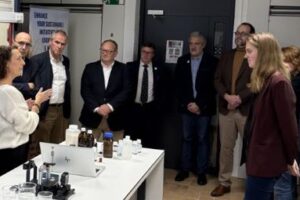
Louvain-la-Neuve, October 23, 2025 — Minagro had the pleasure of welcoming Anne-Catherine Dalcq, Walloon Minister of Agriculture, to its laboratory in Louvain-la-Neuve.
This visit provided an opportunity to present the company’s innovations and exchange views ahead of the upcoming “États Généraux de la Protection des Cultures”, to be launched next week by the Minister.
It was also a valuable occasion to emphasize the crucial role of co-formulants in enabling a realistic, effective, and sustainable agricultural transition.
Innovating for a productive and sustainable agriculture
Faced with the dual challenge of the ecological crisis and food sovereignty, agricultural transition cannot rely solely on eliminating pesticides. It must instead focus on developing credible, safe, and sustainable alternatives.
This is precisely Minagro’s mission: to develop bio-based ingredients that make plant protection products safer, more sustainable, and just as effective.
Linking sustainable agriculture and bioeconomy
Minagro operates at the intersection of two key transitions:
- the shift toward a more resilient and sustainable agriculture, and
- the growth of the bioeconomy, a cornerstone of Europe’s decarbonization strategy.
Agriculture must remain productive to feed a growing global population and provide the biomass required to replace fossil carbon. In turn, the bioeconomy must deliver new, safer ingredients that can support this agriculture of tomorrow. Minagro’s developments aim precisely to replace hazardous co-formulants in agrochemical formulations with high-performance, environmentally responsible alternatives — biodegradable, non-toxic, and compatible with organic farming.
Providing practical solutions for a realistic transition
Minagro focuses on co-formulants — preservatives, adjuvants, and solvents — that are essential for the performance and stability of crop protection products. However, like active ingredients, many conventional co-formulants are now under regulatory pressure, threatening the availability of effective solutions in the field.
By developing biosourced or organic-compatible alternatives, Minagro offers a progressive and pragmatic pathway for agrochemical companies, helping them move step by step toward safer formulations — without sacrificing performance or facing disruptive technological shifts. This is a realistic transition, grounded in concrete, scalable innovations that benefit the industry and, ultimately, farmers.
Addressing regulatory challenges that slow down innovation
During the visit, Minagro highlighted the contradictions within the current European regulatory framework:
- The EU calls for a more sustainable agriculture, but approval processes remain too slow and complex to match the pace of environmental urgency.
- New, greener solutions often don’t fit neatly into existing evaluation categories, delaying market access.
- The cost and duration of registration procedures discourage proactive replacement of risky ingredients, even when safer alternatives exist.
- There is no European incentive for bio-based co-formulants — not even in organic farming — despite their key role in sustainability.
These constraints can delay the market launch of innovative ingredients by up to seven years, while most investors expect returns within five. This misalignment weakens Europe’s innovation ecosystem and competitiveness.
A strong Walloon innovation ecosystem
Despite these challenges, Minagro thrives within a robust Walloon and European innovation network, including Invest.BW, AgriBioCare (supported by AWEX and Wagralim), Wagralim–Greenwin (DG06 Cluster project), Ignity, and several R&D centers. This ecosystem demonstrates that Wallonia already has the talent, infrastructure, and expertise needed to drive a high-performance, sustainable agricultural transition.
However, these solutions require a supportive political and regulatory framework to scale up. The upcoming États Généraux de la Protection des Cultures, organized by the Minister, represent a key opportunity to recognize and strengthen this ecosystem — by supporting realistic, field-based innovations that make agricultural transition both effective and competitive.